Enterprise IT CMDB
Enterprise IT CMDB
Enterprise IT CMDB | Enterprise | 21 Object Types | Enterprise IT
The complete enterprise IT schema: business capabilities, applications, infrastructure, cloud, networking, security, and contracts across three tiers.
Your CMDB project has been running for 18 months. You have server records. You have application records. But when the board asks "what is the business impact of losing the payment processing cluster?", nobody can trace the chain from infrastructure through to business capability. The Enterprise IT CMDB is built to answer exactly that question.
Twenty-one object types across three tiers: Business (capabilities, services, contracts, licences), Application (software systems, microservices, containers, APIs, and databases), and Infrastructure (locations, cloud accounts, servers, VMs, cloud instances, Kubernetes clusters, networking, certificates, DNS, and backups). Everything wired together so you can trace a failing server all the way up to the business service that depends on it, and identify who owns every link in the chain.
What you get
Business tier
| Object Type | Purpose | Key Attributes |
|---|---|---|
| Business Capability | High-level business functions | Capability Name, Owner, Criticality, Strategic Value |
| Business Service | Customer-facing services supporting business capabilities | Service Name, Service Owner, SLA, RPO, RTO, Criticality |
| Technical Service | IT services supporting business services | Service Name, Service Type, Owner, Support Team, Tier |
| Contract | Vendor contracts and agreements | Vendor, Contract Type, Start/End Date, Value, Auto-Renew |
| Software License | Software licences and entitlements | Product, License Type, Quantity, Vendor, Annual Cost, Expiry Date |
Application tier
| Object Type | Purpose | Key Attributes |
|---|---|---|
| Application | Business applications | Application Name, Version, Application Type, Tech Stack, SDLC Phase, Risk Rating |
| Microservice | Service components and microservices | Service Name, Repository, API Endpoint, Health Check URL |
| Container Image | Docker and container images | Image Name, Registry, Version/Tag, Base Image, Scan Status |
| API | Internal and external APIs | API Name, Endpoint, Version, Auth Type, Rate Limits |
| Database | Database instances | Database Name, Database Type, Version, Size, Replication, Encryption |
Infrastructure tier
| Object Type | Purpose | Key Attributes |
|---|---|---|
| Location | Data centres, offices, and physical locations | Location Name, Location Type, Address, Tier Rating, Compliance Certs |
| Cloud Account | AWS, Azure, GCP accounts | Account Name, Account ID, Provider, Environment, Monthly Budget |
| Kubernetes Cluster | Kubernetes clusters | Cluster Name, Provider, Version, Node Count, Environment, GitOps Repo |
| Server | Physical and virtual servers | Hostname, IP Address, Server Type, OS, CPU Cores, RAM, Environment |
| Virtual Machine | VMs and hypervisor guests | VM Name, Host Server, Hypervisor, vCPU, vRAM, Snapshots |
| Cloud Instance | Cloud compute (EC2, Azure VM, GCE) | Instance Name, Instance ID, Instance Type, Region, Monthly Cost |
| Load Balancer | Traffic distribution and load balancers | LB Name, LB Type, VIPs, Health Check URL, SSL Termination |
| Network Device | Routers, switches, firewalls | Device Name, Device Type, IP Address, Manufacturer, Firmware |
| Certificate | SSL/TLS certificates | Domain, Issuer, Expiry Date, Key Size, Auto-Renew |
| DNS Record | DNS entries for services and systems | FQDN, Record Type, Value, TTL, Provider |
| Backup Job | Backup configurations and schedules | Source System, Schedule, Retention, Last Run Status, Success Rate |
Pro tip: Deploy in tier order. Start with the Business tier to establish ownership and criticality. Then deploy Application, then Infrastructure. This order means infrastructure records always have a service to link back to, which is what makes the CMDB useful rather than just a device list.
When to use this schema
Deploy Enterprise IT CMDB if your organisation:
-
Manages complex, multi-site infrastructure with hundreds of servers across physical and cloud environments
-
Needs to trace the full dependency chain from business capability down to physical hardware
-
Has a mature IT function with dedicated teams for infrastructure, applications, and security
-
Requires evidence of configuration management for audit or compliance (ISO 27001, ITIL, SOX)
-
Is migrating from an existing CMDB tool (ServiceNow, Remedy) and needs a comprehensive target schema
This is the most complex schema in JSM LaunchPad. If you are just getting started with CMDB, deploy the Standard CMDB first. You can always migrate to Enterprise IT as your practice matures.
Not quite right? If your infrastructure is primarily cloud-native (no physical data centres), look at Cloud-Native Infrastructure. If you need security-specific tracking (vulnerabilities, controls, compliance), layer on Cybersecurity.
Schema at a glance
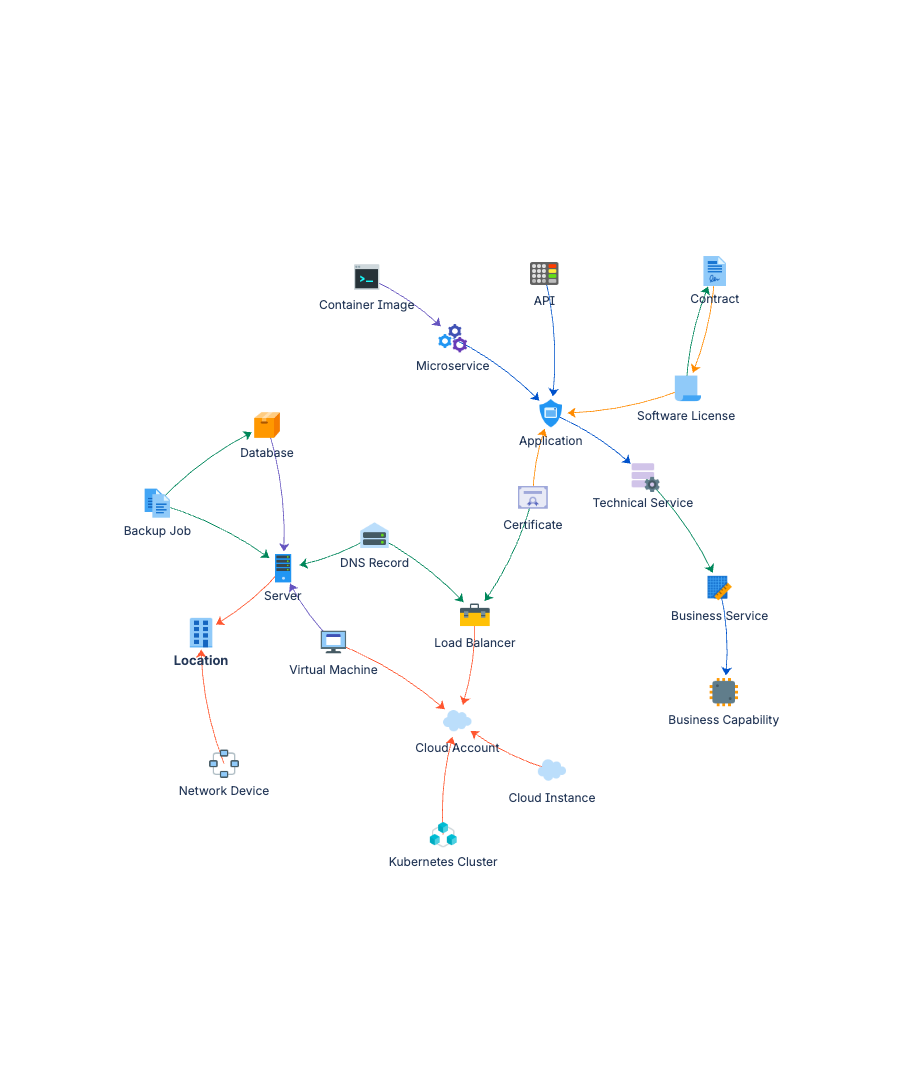
Business Tier
  Business Service ──(Delivered By)──▶ Business Capability
  Technical Service ──(Depends On)──▶ Business Service
  Software License ──(Managed By)──▶ Application
  Software License ──(Depends On)──▶ Contract
  Contract ──(Managed By)──▶ Software License

Application Tier
  Application ──(Delivered By)──▶ Technical Service
  Microservice ──(Delivered By)──▶ Application
  Container Image ──(Runs On)──▶ Microservice
  API ──(Delivered By)──▶ Application
  Database ──(Runs On)──▶ Server

Infrastructure Tier
  Server ──(Located In)──▶ Location
  Virtual Machine ──(Runs On)──▶ Server
  Virtual Machine ──(Located In)──▶ Cloud Account
  Cloud Instance ──(Located In)──▶ Cloud Account
  Kubernetes Cluster ──(Located In)──▶ Cloud Account
  Load Balancer ──(Located In)──▶ Cloud Account
  Network Device ──(Located In)──▶ Location
  Certificate ──(Managed By)──▶ Application
  Certificate ──(Depends On)──▶ Load Balancer
  DNS Record ──(Depends On)──▶ Load Balancer / Server
  Backup Job ──(Depends On)──▶ Database / Server
Documentation
Quick Start Guide Phased deployment guide for all 21 object types, structured by tier. Covers priority ordering, data migration from existing tools, and verification at each phase.
Governance Playbook Enterprise governance practices: federated data stewardship, ownership model across teams, review cadence by tier, and data quality KPIs.
Forms Specification Form layouts for all 21 object types across the Business, Application, and Infrastructure tiers.