Which schema should I choose?
Which schema should I choose?
You have four starter schemas to choose from. Each one is a complete, deployable data model. The right choice depends on what problem you are solving first, not how big your organisation is.
If you just want the short answer: start with Basic CMDB unless you have a specific reason not to. You can always layer on more later.
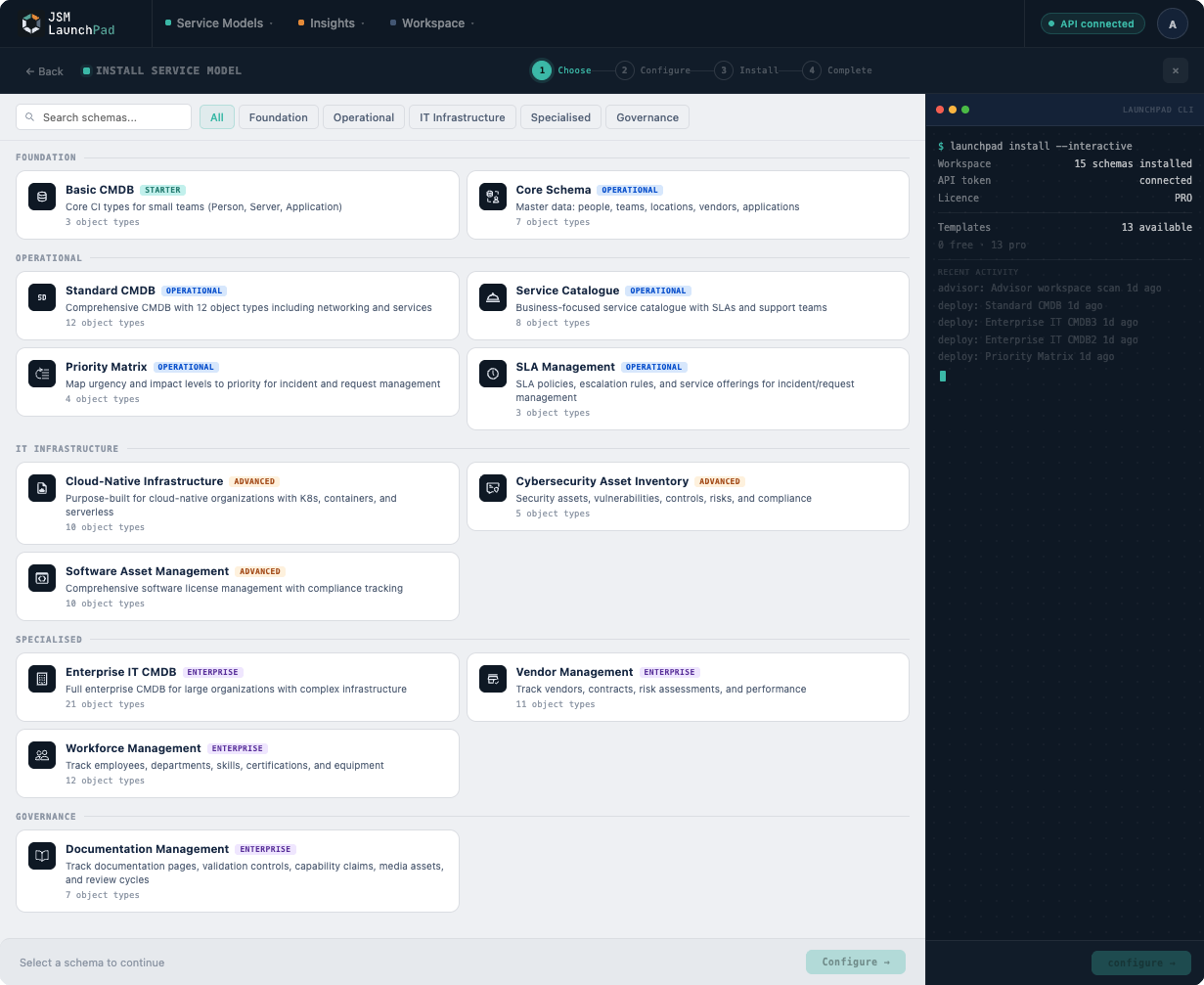
The four starter schemas at a glance
| Schema | Best For | Object Types | Complexity | Tier |
|---|---|---|---|---|
| Basic CMDB | Teams who need asset tracking and service ownership without complexity. First-time CMDB builders. | 4 types (Person, Server, Application, Location) | Starter | Free |
| Core Schema | Teams who need a foundation to build on. Covers people, teams, departments, locations, vendors, and applications. | 7 types including locations, vendors, and cost centres | Operational | Paid |
| Standard CMDB | Organisations with established ITSM processes who need infrastructure tracking, services, and full dependency mapping. | 12 types with deep relationship modelling | Operational | Paid |
| Service Catalogue | Teams focused on service delivery. Maps service offerings to supporting infrastructure and SLAs. | 8 types focused on services, offerings, and support structures | Operational | Paid |
Decision questions
Answer these three questions and the right schema becomes obvious.
1. What is the first problem you want to solve?
| If your priority is... | Start with |
|---|---|
| Knowing what assets you have and who owns them | Basic CMDB |
| Building a foundation you can extend over months | Core Schema |
| Full ITSM maturity: change, incident, problem linked to CIs | Standard CMDB |
| Defining and managing service offerings with SLAs | Service Catalogue |
2. How many people will use the CMDB in the first three months?
| Team size | Recommendation |
|---|---|
| 1-5 people | Basic CMDB or Core Schema. Keep it manageable. |
| 5-20 people | Core Schema or Standard CMDB. You have enough hands to maintain more data. |
| 20+ people | Standard CMDB. Multiple teams means you need clear ownership and process integration. |
3. Do you already have data in Assets?
| Current state | Recommendation |
|---|---|
| Completely empty, starting fresh | Basic CMDB. Learn the model, then expand. |
| Some objects exist but no real structure | Core Schema. It will give you a proper structure to organise existing data. |
| Existing schema that needs extending | Standard CMDB or deploy a complementary schema alongside (see Connecting Schemas Together). |
Still not sure?
Pick Basic CMDB. Seriously. The most common mistake is over-scoping on day one. Basic CMDB gives you a working system in minutes. Once you have real data and real usage patterns, you will know exactly what you need next, and JSM LaunchPad lets you deploy additional schemas alongside your existing one without disrupting anything.
Beyond the starters
The four starter schemas cover the most common use cases, but JSM LaunchPad includes specialist schemas for specific domains. These are available in the Service model reference:
| Schema | Use Case | Complexity | Tier |
|---|---|---|---|
| Cloud-Native Infrastructure | AWS/Azure/GCP resource tracking, container orchestration | Advanced | Paid |
| Cybersecurity | Security controls, vulnerability tracking, compliance frameworks | Advanced | Paid |
| Software Asset Management | Licence management, software lifecycle, vendor contracts | Advanced | Paid |
| Enterprise IT CMDB | Full enterprise scope with 21 object types | Enterprise | Paid |
| Vendor Management | Supplier relationships, contracts, SLAs, risk assessment | Enterprise | Paid |
| Workforce Management | People, teams, skills, certifications, org structure | Enterprise | Paid |
You do not need to choose these upfront. Deploy a starter schema first, get comfortable, then add specialist schemas as your needs evolve.